

Best Puppy Training App for New Owners: Top Picks


For most new puppy owners, Rebarkable’s 52-week structured program is the strongest starting point. It delivers positive-reinforcement lessons week by week, straight to your inbox, with no app store required and no decision fatigue about what to do next. If you need live video coaching or real-time behavior troubleshooting, a LIMA-compliant mobile app with certified trainer access fills that gap well. The two approaches aren’t mutually exclusive, and the best puppy training app or program for you depends on three things: your schedule, your puppy’s current challenges, and whether you want a guided curriculum or on-demand lessons.
A few signals that point you toward the right choice:
- Trainer credentials matter. Look for CCPDT or IAABC certification in any app’s trainer bios. These aren’t just logos; they mean the trainer passed a standardized exam in evidence-based methods.
- Positive reinforcement is non-negotiable for puppies. Fear-based or punitive methods increase the risk of anxiety and aggression later. Any program that hedges on this is a red flag.
- Consistency beats content volume. Daily brief sessions consistently lead to better training outcomes than infrequent, longer sessions.
Quick actions to take today:
- Decide whether you need live coaching (app) or a weekly structured plan (Rebarkable)
- Block 10–15 minutes each morning tied to your puppy’s first potty break
- Subscribe to or trial your chosen program before your puppy hits 12 weeks old, when the socialization window is still wide open
Pro Tip: Set a recurring phone alarm labeled “puppy school” at the same time each day. Tying training to a fixed daily anchor, like the morning potty trip, is the single fastest way to build the habit.
Table of Contents
What do the best puppy training apps actually offer?
The gap between a good puppy training program and a mediocre one usually comes down to structure, not content volume. Top-rated apps and programs combine organized curricula, personalized plans, and trainer feedback as their core differentiators. Here’s what you should expect from any option worth your time:
Mission-critical features for puppies:
- Age-appropriate modules. Socialization windows close fast (roughly 3–16 weeks), so the program needs to address them explicitly, not bury them in a general “manners” section.
- Potty and crate sequencing. These two skills are interdependent. A program that teaches them in isolation misses the connection.
- Bite inhibition guidance. Mouthing is normal; the timing of correction matters enormously.
- Daily tasks and reminders. Without a prompt, most owners skip sessions. A push notification or weekly email keeps the habit alive.
- Progress tracking and milestones. Knowing your puppy can now sit reliably in three out of five attempts is motivating. Vague “keep going!” feedback is not.
Nice-to-have features:
- Video lesson libraries for visual learners
- Enrichment ideas (supervised lick mat sessions, puzzle feeders)
- Health-check integrations or vet-advice prompts
- Community forums or Q&A threads for peer support
The biggest structural difference is between self-guided content, templated weekly plans, and live trainer access. Self-guided works if you’re disciplined. A templated weekly plan removes the “what do I do today?” friction that derails most new owners. Live trainer access is where things get genuinely powerful for behavior problems, because certified trainer support reduces the time it takes to solve common puppy issues compared to self-guided lessons alone.
Mobile-first design and offline video access are worth checking before you commit. If the app buffers every time you’re at the park, you’ll stop using it.

What does puppy training actually cost?
Pricing varies more than most new owners expect, and the cheapest option isn’t always the best value. Here’s a realistic breakdown of what you’ll find across apps and subscription programs:
| Tier | Typical Monthly Cost | What’s Usually Included |
|---|---|---|
| Free / basic | — | Limited lessons, ads, no trainer access |
| Entry-level subscription | $6–$15/mo | Full lesson library, reminders, progress tracking |
| Mid-tier with coaching | $12–$30/mo | All above plus live chat or async trainer Q&A |
| Annual plan (most programs) | $50/yr | Full curriculum, often 30–40% cheaper than monthly |
| Per-session live coaching | $30/session | One-on-one video call with a certified trainer |
A few things to watch for:
- Free tiers are often bait. The core curriculum is usually locked behind a paywall. Use the free tier to test UX, not to train your puppy.
- Annual plans save money if you’re committed. Most programs offer 30–40% off when you pay upfront.
- Per-session coaching adds up fast. If you anticipate needing regular live help, a subscription with coaching bundled in is almost always cheaper than paying per session.
- One-time course purchases exist and can be good value for owners who want a specific skill (crate training, recall) without an ongoing subscription.
For a full picture of what puppy training costs across different formats, Rebarkable’s puppy training cost guide breaks it down clearly.
Why training methods matter more than features
The most polished app in the world will cause harm if it’s built on the wrong methods. This is the part most comparison articles gloss over, and it’s the part that matters most for your puppy’s long-term behavioral health.

Positive reinforcement means adding something the dog wants (a treat, praise, play) immediately after a desired behavior to make that behavior more likely to happen again. It’s not bribery. It’s not permissiveness. It’s the most thoroughly researched approach in animal learning science, and it’s what LIMA-compliant trainers use as their default.
LIMA stands for Least Intrusive, Minimally Aversive. It’s a decision-making framework, not a single technique. A LIMA-compliant program tries the gentlest effective approach first and only escalates if needed. For puppies, this almost always means reward-based training stays the primary tool throughout.
Credentials to look for in any app’s trainer bios:
- CCPDT (Certification Council for Professional Dog Trainers)
- IAABC (International Association of Animal Behavior Consultants)
- Fear Free Certified
- Veterinary behaviorist (DACVB)
Red flags that should make you walk away:
- Vague “balanced training” language without defining what that means
- References to “dominance,” “pack leadership,” or “alpha” methods
- Punitive tools recommended without clear LIMA justification
- No trainer bios or credentials listed anywhere
You can verify credentials quickly: go to the trainer bio section of any app, copy the trainer’s name, and search the CCPDT trainer directory or IAABC member search. It takes two minutes and tells you everything.
Apps vs. a structured weekly program: which fits your life?
Both formats work. The question is which one fits your schedule, your learning style, and your puppy’s current needs. Here’s an honest side-by-side:
| Category | Mobile App | Structured Weekly Program (e.g., Rebarkable) |
|---|---|---|
| Best for | Owners who want on-demand video and live coaching | Beginners who want a clear weekly plan with no guesswork |
| Training approach | Varies; confirm LIMA/positive-reinforcement before subscribing | Positive-reinforcement first, week-by-week curriculum |
| Trainer access | Live chat or video call (tier-dependent) | Email-based expert guidance and community support |
| Key features | Video library, real-time reminders, in-app tracking | Weekly email lessons, blog resources, community Q&A |
| Pricing shape | Monthly or annual subscription; coaching often add-on | Affordable weekly or annual subscription |
| Onboarding ease | App download, account setup, quiz-based personalization | Subscribe, receive first email, follow the week’s steps |
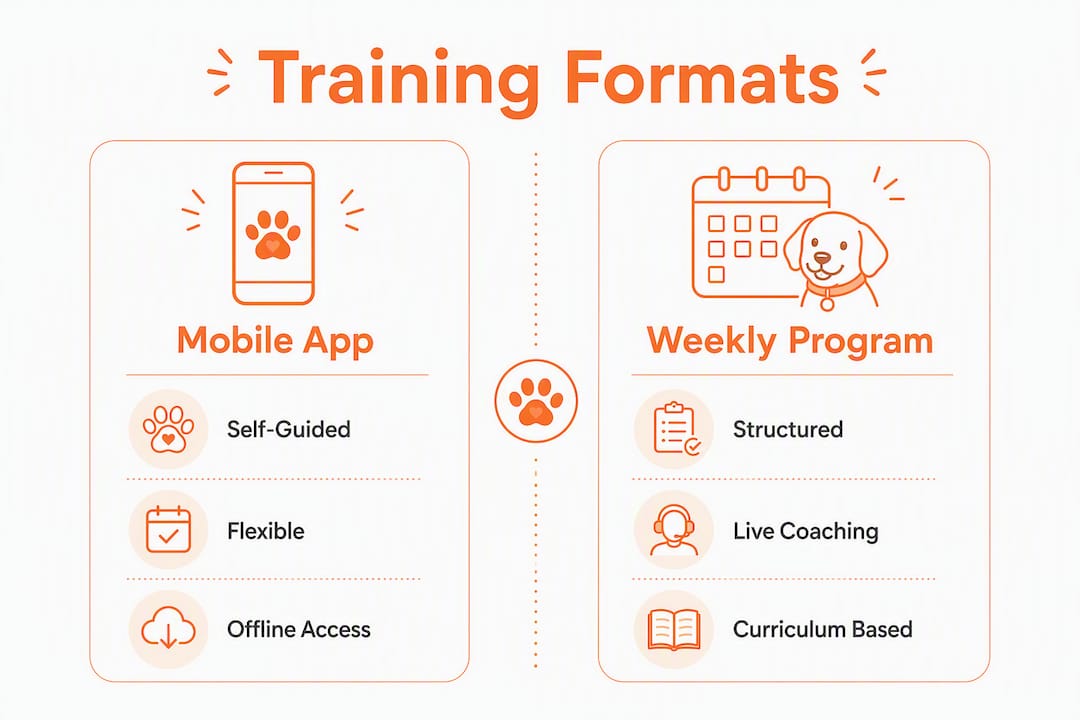
Apps win on interactivity. If your puppy is resource-guarding or showing early fear responses, a live trainer on a video call is genuinely hard to replace. The visual feedback loop, where a trainer watches your technique and corrects it in real time, is something no email curriculum can fully replicate.
A structured weekly program wins on cognitive load. When you’re sleep-deprived and your puppy just had an accident at 2 AM, opening an app and deciding which lesson to do next is friction you don’t need. A weekly email that says “this week, focus on crate habituation and name recognition” removes that decision entirely.
For new owners who feel overwhelmed by the sheer number of options, a predictable weekly cadence is often the difference between sticking with training and quietly giving up by week three.
For a deeper look at how online and in-person formats compare, Rebarkable’s online vs. in-person training review is worth reading before you decide.
Pro Tip: Use both formats strategically. Run Rebarkable’s weekly curriculum as your backbone and use a LIMA-compliant app for on-the-go reinforcement when you’re at the park or vet’s office.
How to choose the right app or program for your puppy
This doesn’t need to be complicated. Run through this checklist before you pay for anything:
Step-by-step evaluation:
- Define your top three training goals (potty training, crate comfort, bite inhibition, basic cues). Any program that doesn’t address all three in its first month isn’t built for puppies.
- Confirm the training philosophy. Search the app’s website or app store description for “positive reinforcement” or “LIMA.” If neither appears, dig deeper before committing.
- Check trainer credentials. Find the trainer bios. Look for CCPDT, IAABC, or Fear Free certification. No bios listed? That’s a red flag.
- Compare trial periods. Most reputable apps offer 7–14 day free trials. Use the trial to test the onboarding flow, not just browse the lesson library.
- Assess daily time expectations. If the program assumes 45 minutes a day, be honest about whether that’s realistic for your schedule.
- Review the refund policy. A program confident in its results offers a clear refund window. Vague cancellation terms are a warning sign.
- Test device compatibility. Confirm iOS and Android parity, offline video access, and whether multiple family members can share one account.
Red flags to avoid:
- No trainer credentials listed anywhere
- “Dominance-based” or “balanced” language without LIMA clarification
- No age-appropriate puppy content (a dog training app that lumps 8-week puppies with adult dogs isn’t built for your situation)
- Aggressive upsells for one-on-one sessions within the first few days of a free trial
Pro Tip: Before starting a free trial, pick two or three specific behaviors to work on, sit, name recall, and crate entry, and track your puppy’s progress daily. At the end of the trial, you’ll have real data on whether the program works for your dog, not just a general impression.
Your first 30 days: a practical starter plan
The first month sets the tone for everything that follows. Here’s how to structure it whether you’re using an app, Rebarkable’s program, or both.
Week 1: Foundation and potty basics
- Set a potty schedule: outside every 1–2 hours, immediately after waking, eating, and playing.
- Introduce the crate as a positive space using treats and short, supervised sessions (5–10 minutes).
- Start name recognition: say the puppy’s name, mark with “yes!” and reward with a small treat.
- Begin bite inhibition: when teeth touch skin, go still and redirect to a toy immediately.
Week 2: Building cues and crate comfort
- Add “sit” using a lure (treat held above the nose, moved back slowly).
- Extend crate sessions to 20–30 minutes with a lick mat smeared with peanut butter or wet food inside. Always supervise early sessions; puppies can chew and ingest pieces of softer mats.
- Practice name recall across short distances indoors.
- Introduce one new surface, sound, or person per day for socialization.
Week 3: Proofing and early socialization
- Practice “sit” in three different locations (kitchen, yard, living room).
- Start short leash walks in low-distraction areas.
- Add “down” using a lure from the sit position.
- Continue crate training with the door closed for 30–45 minutes.
Week 4: Consolidation and troubleshooting
- Review all cues in a slightly distracting environment.
- Introduce home-alone training in small increments (5 minutes, then 10, then 20).
- If potty accidents are still frequent after three weeks on a consistent schedule, consult your vet to rule out a UTI or other medical cause.
- If you’re seeing fear responses or growling, this is the moment to escalate to a live certified trainer, not to push through on your own.
Gear that makes a real difference:
- Treat pouch: A sleek, waist-worn pouch with a magnetic or zipper closure lets you reward within the critical seconds window. Bulky bags cause fumbling and missed reinforcement timing. Keep the pouch out of the puppy’s sightline between rewards to avoid treat-source dependency.
- Lick mat: Great for crate habituation and calming during nail trims or vet visits. Supervise every session until you’re confident your puppy licks rather than chews.
- Bite inhibition guide: Mouthing escalates fast without a clear protocol. Have one ready before week one.
Key Takeaways
The best puppy training app or program is the one built on positive reinforcement, delivered by credentialed trainers, and structured to match your puppy’s developmental stage week by week.
| Point | Details |
|---|---|
| Positive reinforcement is the baseline | Only use apps or programs that explicitly state LIMA or reward-based methods in their curriculum. |
| Credentials signal trustworthiness | Look for CCPDT or IAABC certification in trainer bios before subscribing to any paid plan. |
| Live trainer access speeds troubleshooting | Apps with certified trainer access reduce time-to-solution for behavior problems compared to self-guided content alone. |
| Structured weekly plans reduce overwhelm | A predictable weekly curriculum removes daily decision friction, which is the most common reason new owners quit. |
| Rebarkable is the recommended starting point | Rebarkable’s 52-week positive-reinforcement program delivers week-by-week guidance to your inbox, covering potty training, crate habits, and early cues. |
The thing most puppy training content gets wrong
There’s a version of this conversation that treats every puppy training app as roughly equivalent and tells you to just “pick one and stay consistent.” That framing frustrates me, because it sidesteps the part that actually matters: the methodology underneath the interface.
A beautifully designed app built on dominance-based methods will produce a dog that complies out of fear, not understanding. That might look like success at 6 months and look like a behavior crisis at 18 months. The research on this is not ambiguous.
What I’ve seen work, consistently, is a structured positive-reinforcement curriculum that meets owners where they are. Not a library of 200 videos that requires you to self-direct your learning. Not a per-session coaching model that costs $60 every time your puppy does something new. A predictable weekly plan that says: here’s what matters this week, here’s why, here’s how to do it in 15 minutes a day.
The other thing worth saying plainly: apps are tools, not trainers. The best dog training app for puppies is the one that makes you a better trainer, not the one with the most features. If a program is so complex that you spend more time navigating it than training your dog, it has failed at its actual job.
Rebarkable’s 52-week program is built for exactly this moment
New puppy owners don’t need more content. They need the right content, in the right order, at the right time. Rebarkable’s 52-week positive-reinforcement program delivers exactly that: weekly email lessons covering potty training, crate habituation, bite inhibition, socialization, and basic cues, paced to match your puppy’s developmental stage.

Every week, you get a clear action plan, no app to navigate, no library to sort through. The curriculum is built on LIMA-compliant, evidence-based methods, and it’s supported by a full blog resource library and community. Start with the puppy toilet training guide for an immediate win, then let the weekly program carry you through the rest of the first year.
If you decide you also need live coaching for a specific behavior issue, that’s a completely valid call. Rebarkable is the backbone; live coaching fills the gaps. Head to Rebarkable.com to see the full program and get started.
This article is general educational information, not professional veterinary or behavioral advice. For persistent fear, aggression, or medical concerns, consult a certified veterinary behaviorist or your vet directly.
Useful sources and further reading
These are the primary sources and reputable references used throughout this article: